


A Ponte Vedra Homeowner’s Guide to Diagnosing Salt Chlorination Problems Before They Become Expensive
A saltwater pool can look perfectly normal while the salt chlorination system is no longer producing enough chlorine.
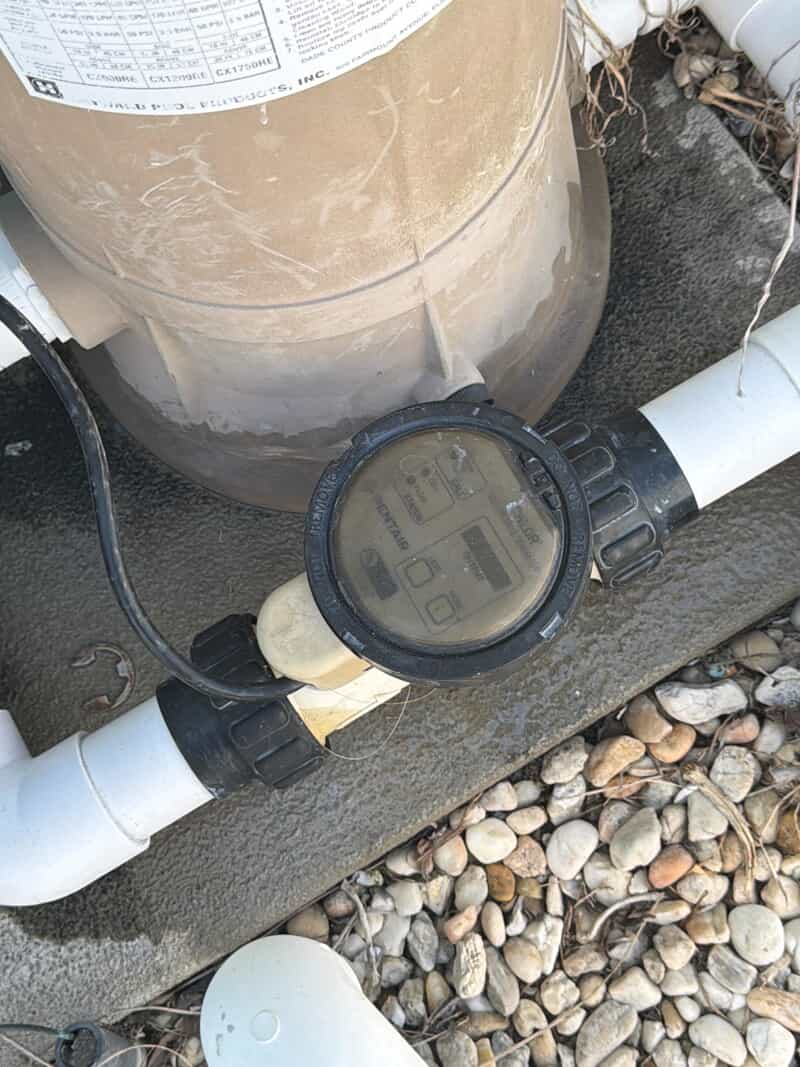
The controller may still have power. The pump may be running. The salt level may appear normal. But if the pool consistently has little or no free chlorine, the salt system may not be operating correctly — and the problem is rarely as simple as it first appears.
At ASP – America’s Swimming Pool Company of Ponte Vedra, we regularly diagnose salt systems throughout Ponte Vedra, Ponte Vedra Beach, Nocatee, Jacksonville Beach, Atlantic Beach, Neptune Beach, and Palm Valley that appear to be “on” but are not actually producing enough chlorine to maintain the pool.
August is one of the most common months we see this issue surface. Peak heat, high bather load, and frequent afternoon storms push chlorine demand to its highest point of the year — and a salt cell that was barely keeping up in June will often show its limits by mid-summer.
So how can you tell whether your salt cell is really working?
A Salt Pool Is Still a Chlorine Pool
One of the most common misunderstandings about saltwater pools is that they do not use chlorine.
They do.
A salt chlorination system uses dissolved salt in the pool water to generate chlorine through a process called electrolysis. Instead of relying entirely on manually added chlorine, the salt cell produces it continuously as properly salted pool water passes through the system.
If the salt system stops producing properly, the pool can develop the same problems as any other pool with insufficient sanitizer:
- Low or zero free chlorine
- Cloudy water
- Algae growth — particularly common during Northeast Florida’s hot, storm-heavy August
- Increased chlorine demand that chemicals alone can’t seem to satisfy
- Difficulty maintaining water quality despite normal-looking controller readings
That is why it is important to look at more than whether the controller simply has power.
.jpg)
Signs Your Salt Cell May Not Be Working
Low or Zero Free Chlorine
This is one of the clearest warning signs. If the salt system appears to be operating normally but repeated water testing shows little or no free chlorine, the system may not be generating properly.
Low chlorine does not automatically mean the salt cell has failed. Other factors can also contribute — and in Northeast Florida’s summer conditions, several of them often occur at the same time:
Possible Cause | What’s Happening | Common in Ponte Vedra? |
Insufficient pump run time | Cell only generates chlorine when pump is running — too few hours means too little output | Very common — many pools are still on spring schedules in August |
Low stabilizer (CYA) | UV destroys unprotected chlorine within hours | Common — CYA drops when water is diluted by rain |
Heavy swimmer use | Sunscreen, sweat, and body oils rapidly consume chlorine | Peak in July–August |
Algae or organic contamination | Active algae consumes chlorine as fast as it’s generated | Frequent after summer storms |
Incorrect output settings | Cell may be set too low for summer demand | Often not adjusted seasonally |
Incorrect salt level | Too low or too high both impair chlorine generation | More common after heavy rain dilution |
Poor water flow | Cell needs adequate flow to operate — flow issues reduce output | Can develop gradually as filters load up |
Low water temperature | Electrolysis efficiency drops below 60°F | Less of a summer issue — more relevant in cooler months |
Consistently low or zero chlorine despite a running system should never be ignored — especially in summer when algae pressure is highest.
Warning or Check Cell Lights
Many salt systems display warning lights, error messages, or service indicators when something is wrong. Depending on the manufacturer and model, these may include:
- Low salt
- High salt
- No flow
- Check cell
- Inspect cell
- Service required
The exact meaning of each indication depends on the system. A warning light doesn’t always mean the cell has failed — but it always means something needs attention.
No Generating Indicator
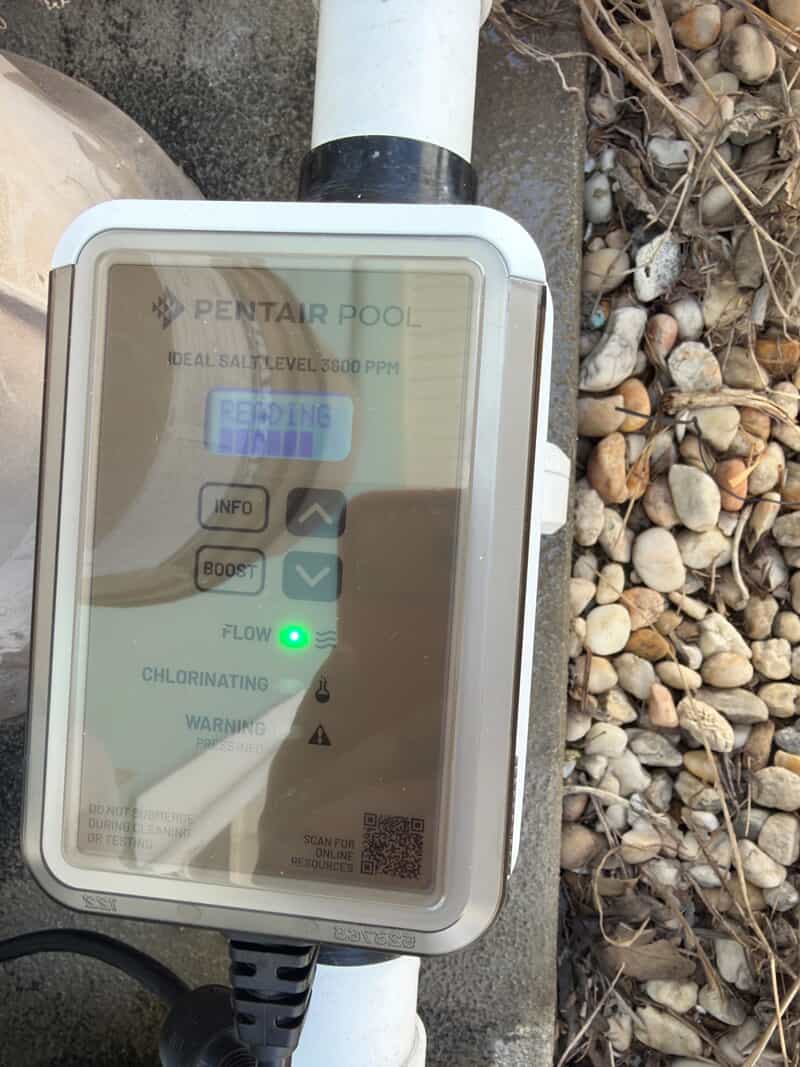
Most salt chlorination systems have some indication that the unit is actively generating chlorine. If the system is powered on but is not showing a generating or production indication when it should be, further evaluation is needed even if everything else appears normal.
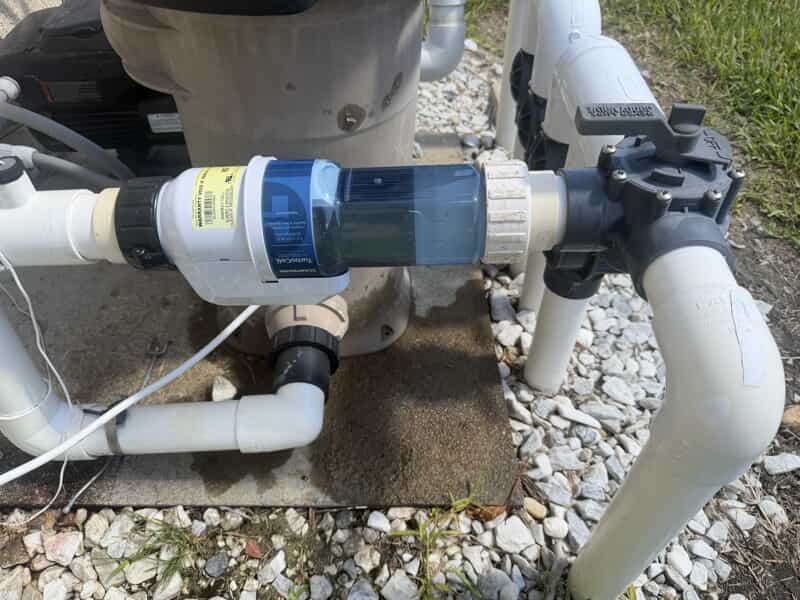
Heavy Calcium Buildup on the Cell
Calcium scale can form on the metal plates inside a salt cell, and Northeast Florida’s hard, mineral-rich groundwater accelerates this process compared to many other regions. Heavy buildup interferes with the electrolysis process and reduces chlorine output — sometimes significantly — before any warning light appears.
The cell should be inspected periodically and cleaned based on its actual condition and the manufacturer’s recommendations. Unnecessary or overly aggressive acid cleaning can shorten the life of some cells, so inspection before cleaning matters.
The Cell Is Reaching the End of Its Service Life
Salt cells do not last forever. The useful life of a salt cell varies based on:
- Cell size relative to pool size
- Output percentage — cells running at 100% wear faster than those running at 70%
- Pump run time and total operating hours
- Water chemistry — particularly calcium hardness and pH
- Frequency and severity of calcium buildup
In our market, where pools run throughout the year and summer chlorine demand is high, cells that are run hard often reach the end of their useful life faster than the manufacturer’s estimate. A heavily used or undersized cell may need replacement in 3–5 years; a properly sized system operating at moderate output in well-maintained water can last 7 years or more.
Does a Normal-Looking Controller Mean the Salt Cell Is Working?
Not necessarily.
A controller can have power, display normal information, and show no warning lights while the cell is producing little or no chlorine. The controller and the cell are two separate components — one can function normally while the other does not.
The best way to evaluate a salt system is to look at the entire picture:
- Is there adequate water flow through the cell?
- Is the salt level actually correct — not just reading “OK” on the display?
- Is the cell clean and free of calcium buildup?
- Is the controller showing any warnings, even intermittent ones?
- Is the system actively indicating chlorine production?
- Is the output percentage appropriate for current water temperature and bather load?
- Is the pump running long enough each day to allow adequate chlorine generation?
- Is the pool actually maintaining free chlorine at a safe level?
A salt system should be judged by whether it is maintaining the pool — not simply by whether the display is illuminated.
Why Does My Salt Pool Have Zero Chlorine?
There are several possible explanations, and they are not all equal in terms of cost or urgency:
Possible Cause | Typical Fix | Estimated Cost |
Insufficient pump run time | Increase daily run time to 10–12 hours | $0 — schedule adjustment only |
Incorrect output setting | Increase SCG output % for summer conditions | $0 — controller adjustment only |
Low or incorrect salt level | Add salt to reach target range (2,700–3,500 ppm) | $20–$60 in salt |
Low stabilizer (CYA) | Add stabilizer or adjust water balance | $20–$80 in product |
Calcium scale on cell | Professional cell inspection and cleaning | $75–$150 |
Flow switch or controller issue | Diagnosis and repair or replacement | $150–$400 |
Worn or failed salt cell | Salt cell replacement | $900+ depending on model |
Complete salt system replacement | Full system swap including controller | $1,200–$2,500+ installed |
Prices are industry-range estimates for the Northeast Florida market. Actual costs depend on equipment brand, model, and pool configuration.
This is why replacing the cell without diagnosing the full system first can be an expensive mistake. The same symptom — zero free chlorine — can have a $0 fix or a $1,500+ fix depending on what’s actually causing it.
Our Honest Recommendation
Call for a professional diagnosis if:
- Free chlorine remains consistently low or zero despite the system appearing to run normally
- The controller is showing warning or service lights
- The system is not displaying an active generating or production indicator
- Salt readings appear inaccurate or inconsistent
- The cell repeatedly develops heavy calcium scale
- The cell is 4 or more years old and performance has declined
- You are unsure whether the problem is the cell, the controller, the water chemistry, or the pump run time
You may be able to adjust this yourself first if:
- The only issue is low free chlorine and your pump has been running fewer than 10 hours per day — try extending the schedule before assuming a hardware problem
- The salt level has dropped after recent heavy rain — test accurately and add salt if needed
- The output percentage hasn’t been adjusted since spring — bump it up for summer conditions
Do not delay if:
- The pool has visible algae alongside low or zero chlorine — algae consumes chlorine faster than the cell can produce it, and the situation compounds quickly in August heat
Professional Salt System Diagnosis and Service in Ponte Vedra
At ASP – America’s Swimming Pool Company of Ponte Vedra, we provide:
- Salt cell inspection, cleaning, and performance testing
- Full salt system diagnosis — cell, controller, flow switch, and water chemistry
- Salt cell replacement and full salt system installation
- Pump run time and SCG output calibration for summer conditions
- Water chemistry testing and balancing, including salt and stabilizer levels
- Weekly pool maintenance and preventative care
We proudly serve: Ponte Vedra • Ponte Vedra Beach • Nocatee • Jacksonville Beach • Atlantic Beach • Neptune Beach • Palm Valley • Sawgrass and surrounding Northeast Florida communities
Schedule a Salt System Evaluation Today
If your saltwater pool isn’t maintaining chlorine — or you’re not sure whether your salt cell is actually working — the right first step is an accurate diagnosis, not an expensive parts replacement.
We’ll evaluate the full system, identify the actual cause, and recommend the right fix for your specific equipment and water conditions.
Call ASP – America’s Swimming Pool Company of Ponte Vedra
(904) 300-2379 or request service online.
Because pool ownership should be the fun part—we’ll handle the rest.