


The Short Version
A pool light that's gone dark usually comes down to one of a few things. Most often it's the light itself, a bulb at the end of its life, water creeping past the front gasket, or water sneaking in through the conduit behind the fixture. But not always: sometimes the light is fine and the real culprit is electrical, a failing low-voltage transformer or a tripped or bad breaker. The fixture-related issues are fixed either with a fresh LED bulb and a new gasket installed together, or, when water's coming from behind, a full fixture replacement. The electrical issues are a different fix entirely. Figuring out which one you're actually dealing with is the part that saves you money, and it's exactly what we do for pool owners across Panama City Beach, Rosemary Beach, and Lynn Haven.
Why a Dark Pool Is a Bigger Deal on the Emerald Coast
Down here, the pool doesn't shut off when the sun does. Long, warm Gulf Coast evenings mean a lot of swimming, entertaining, and just sitting by the water after dark, and a single working light is what makes that possible and safe. When it goes out, the steps vanish into shadow, the deep end turns into a black hole, and the backyard you paid good money for stops being usable at night.
There's also a coastal wrinkle worth understanding. Salt-laden air, relentless summer humidity, and near-year-round use are tough on the rubber and silicone seals inside a pool light. Gaskets that might last a decade in a milder, drier climate can give out sooner here. So if you own a pool near the beach and your light has started flickering, fogging, or filling with water, the environment may be working against you, and that's not a reason to panic, just a reason to get it looked at by someone who understands coastal pools.
Why Your Light Failed (and How to Read the Clues)
Before assuming the fixture is bad, it's worth knowing that a dark pool light isn't always the light's fault. Here are the usual suspects, from the simplest to the most involved.
The breaker or transformer (check this first)
Sometimes the light itself is perfectly fine and the problem is electrical. A tripped or failed breaker can cut power to the light entirely, and if you have a low-voltage system, the transformer that steps the power down can wear out or fail, leaving an otherwise good light dark. This is the best-case scenario of all, because resetting a breaker or replacing a transformer is far less involved than opening up the fixture. It's also why a good technician checks the power source before ever touching the light.
The bulb simply burned out
Old-school incandescent and halogen pool bulbs are only rated for roughly 1,000 to 5,000 hours, often just one to three swim seasons. When one of these reaches the end of the road, you've caught a lucky break: it's the cleanest path to an LED upgrade.
Water got past the front gasket
Behind the glass lens sits a rubber gasket (an O-ring) that keeps water out. Years of heating and cooling make it shrink and crack, and eventually water seeps in and reaches the bulb. This is one of the most common failures we see on older Bay County pools.
Water got in through the conduit behind the fixture
This is the sneaky one. Where the power cord enters the back of the housing and travels through the conduit, a failed seal can let water in from behind, somewhere you'll never spot from the pool deck. It's a more serious failure, and it changes the whole game plan.
Here's the honest truth we share with every customer: even seasoned pros often can't tell from the surface exactly where the problem is. A bad transformer, a front-gasket leak, and a conduit leak can all leave you with the same dark light. That's why we start at the power source and work inward, and why a careful diagnosis sometimes takes more than one look. We'd rather be upfront about that than guess with your money.
What the Repair Actually Looks Like
When it's the bulb or the gasket: we replace both, together
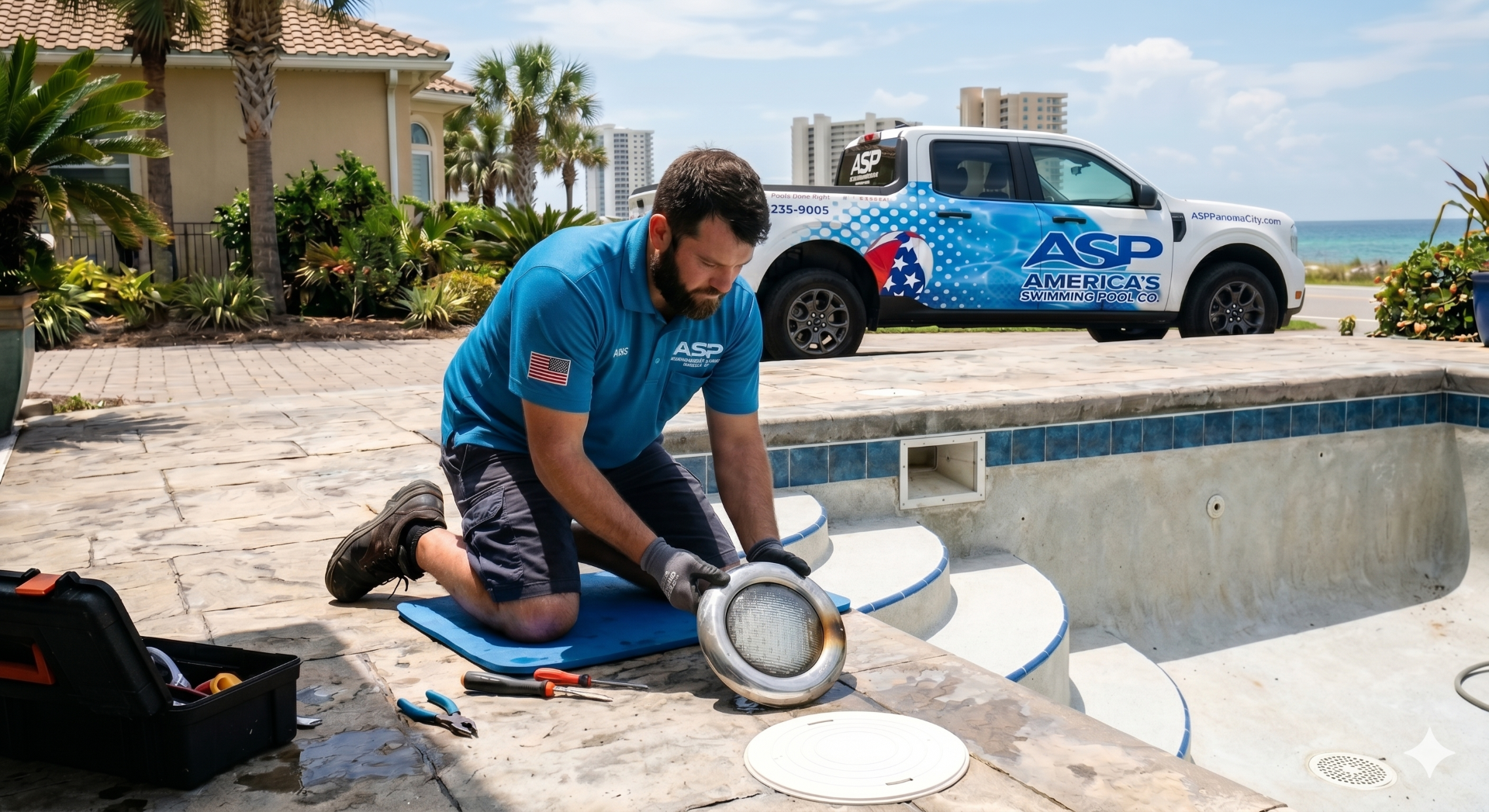
On a classic Pentair Amerlite-style fixture, the most common older light in the Panama City area, we never replace just the bulb or just the gasket. They're always done as a pair, and there's a good reason for that rule.
The moment we open the lens to reach the bulb, the gasket has to come off. And a gasket should never go back on once it's been removed, reusing an old seal is the single biggest cause of a "repaired" light that starts leaking again a month later. On top of that, if water came in through the gasket in the first place, the new gasket is the repair. Since we're already in there, swapping the tired old incandescent bulb for a bright, efficient LED is a no-brainer.
So whether your light died from a worn-out bulb or a leaky gasket, you get the same fix: a new LED upgrade bulb plus a fresh gasket, done in one trip. Most Amerlite fixtures take a screw-in (Edison base) LED, so you get the upgrade without disturbing the niche or rewiring anything.
When it's the conduit: the fixture gets replaced
If the leak is coming from the cord-and-conduit connection behind the fixture, the housing itself is compromised and the right move is a full fixture replacement. We also follow a simple field rule: if we've already done a bulb-and-gasket repair and water keeps coming back, that's the tell that the leak is behind the fixture where we can't seal it from the front. At that point, replacing the whole light is the dependable, one-and-done solution instead of chasing the same leak twice.
Picking Your New Light: White vs. Color
The entire industry has moved to LED, and honestly, it's a great time to upgrade. Pentair, Hayward, Jandy, and the rest all make LED options sized to fit the older niches common around here. The real decision is the look you want.
Bright white LED gives you clean, crisp light for evening swims. It's the efficient, no-frills choice and usually the most affordable upgrade.
Color-changing LED is the showstopper. Solid colors, programmed light shows, control from a wall switch, remote, or your phone, this is the upgrade that turns a backyard into something that feels like the resorts our Rosemary Beach and 30A neighbors are used to. It's the option most homeowners get excited about once they see it in action.
Either way, the math favors LED. These lights run 20,000 to 30,000 hours, often 10 to 20 years, versus one to three years for the old bulbs. They run cooler, use a fraction of the power, and put an end to the every-summer service call to swap a dead bulb.
Does Your Pool Have a Niche Light or a "Pipe" Light?
This matters, because it changes everything about the repair.
Older pools typically have a big fixture sunk into a recessed niche in the wall, with the cord running through conduit to a junction box on the deck. These are the flexible ones, you've got the full menu of options: a bulb-and-gasket LED upgrade, or a full fixture swap.
Newer pools, including a lot of the recent builds around Panama City Beach and Lynn Haven, often use what the trade calls nicheless lights. These thread into a standard 1.5-inch pool wall fitting, the same size pipe as a return jet, with no niche at all. Compact units like the Pentair MicroBrite are built for this and run on low-voltage (usually 12V) back to a transformer or junction box.
The catch with nicheless lights: there's no bulb to swap. The light and its cord are one sealed piece, so when it fails, the fix usually means pulling a whole new light through the pipe from the junction box. It's a different job than a traditional fixture, and worth knowing before you assume it's a quick bulb change.
What's Coming Next: Twist-Out, Plug-and-Play Lights
The technology keeps getting friendlier to pool owners. Manufacturers are rolling out plug-and-play lights designed to make future replacements almost effortless, instead of fishing a new cord all the way back to the junction box, you twist the old light out (which unplugs it) and twist a new one in. Several brands are building this into their latest nicheless and retrofit lines. It points to a near future where a failed pool light is a five-minute swap, not a half-day project.
If you're planning a new build or a serious lighting overhaul, ask us whether a plug-and-play setup makes sense for you. It can take a real bite out of the cost and hassle of every replacement down the line.
Panama City Pool Light Pricing: What to Expect
Every pool is a little different, but here are honest 2026 ballpark ranges:
- LED bulb + gasket, installed: roughly $300–$500. That covers the upgraded LED bulb, a new gasket, and labor, priced as one service, because the two are always done together.
- Full LED fixture, installed: typically $1,000–$2,500 per light, depending on the brand and model you choose and whether any conduit or junction-box work is needed.
- Color systems and multi-light setups: toward the upper end or beyond, especially when adding a controller or updating older wiring.
Pools that are 15+ years old sometimes need conduit or junction-box attention, which can add to the job. The only way to give you a real number is to look at your actual pool, and we're always happy to put a clear, written estimate in your hands before any work starts.
Panama City Beach Pool Light FAQs
Do you service Rosemary Beach and Lynn Haven, or only Panama City Beach? We cover Panama City Beach, Panama City, Rosemary Beach, Lynn Haven, and the surrounding Bay County communities. Not sure if you're in range? Just ask, we'll let you know right away.
Will you need to drain my pool? Almost never. We lift the fixture out and bring it up onto the deck to work on it, so the water level usually stays right where it is.
My light fogs up but still works. Should I wait? Don't wait. Fogging or a little water inside the lens means the seal is already failing. Catching it early often means a straightforward bulb-and-gasket repair instead of a full fixture replacement later, and it keeps water away from the electrical components.
Can I drop an LED bulb into my existing fixture myself? Often the fixture will accept a screw-in LED, but there are two real cautions. We always replace the gasket at the same time (the seal can't be reused once disturbed), and the bulb voltage, 12V vs. 120V, has to match your system exactly. Getting it wrong can ruin the bulb or create a hazard, which is why professional installation is the safer call.
My light is completely dark, is it always the bulb or fixture? Not necessarily. Before we touch the fixture, we check the power source. A tripped or bad breaker, or a failing low-voltage transformer, can leave a perfectly good light dark, and those are quicker, less expensive fixes than anything involving the fixture itself. Starting there means you never pay to replace a light that was working all along.
How long will an LED last in our coastal climate? The LED itself is rated for 20,000 to 30,000 hours (10 to 20 years). In a salt-air environment, the seals and gaskets are usually what need attention first, which is one more reason we use fresh, quality gaskets on every job.
Let's Get Your Pool Glowing Again
A correctly diagnosed pool light is the difference between a sensible repair and an unnecessary fixture replacement, and that diagnosis comes down to knowing exactly where the water is getting in. That's our everyday work for pool owners across Panama City Beach, Panama City, Rosemary Beach, and Lynn Haven.
Whether you need a quick bulb-and-gasket LED upgrade, a full fixture replacement, or you want to talk through color-changing and plug-and-play options, we'll walk you through every choice and help you land on what's right for your pool and your budget.
Reach out to ASP of Panama City Beach today to schedule your pool light evaluation, and let's bring your backyard back to life after dark.
How to Reach Us
Ready to get started, or just have a question? There are two easy ways to reach ASP of Panama City Beach:
- Call us: (850) 604-4417
- Request service online: Fill out the contact form at asppoolco.com/panama-city and we'll get right back to you.
We serve Panama City Beach, Panama City, Rosemary Beach, Lynn Haven, and the surrounding Bay County communities.
Provided as general guidance by ASP — America's Swimming Pool Company of Panama City. Pool light and electrical work should always be handled by a qualified pool professional. FL Contractor License CPC1459606.