


Your heater is running, the pump is on, and the water is cold. It happens to a lot of North Texas pools in November and December, and a large share of the service calls we take in that window turn out to be one of the six faults below.
This is the diagnostic order we work in, not a homeowner's checklist. It goes flow first, because flow is the most common cause and the easiest to rule out, then gas, then ignition. Work it in sequence and you'll either find the fault or walk a technician straight to it.
Stop and get out of the house. Do not touch the heater, do not flip the breaker, do not turn a light on or off, and do not use a phone anywhere near the equipment. Get everyone outside, then call 911 or your gas utility from a safe distance.
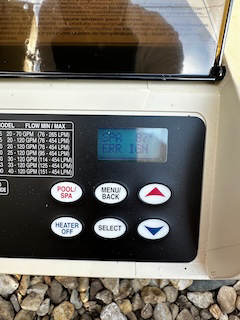
Close-up of a pool filter pressure gauge showing a high reading
A gas odor means gas is already escaping. The breaker you'd instinctively reach for is an electrical switch, and an arc at a switch is one of the classic ignition sources in a gas incident. Nobody should be operating anything in that building until the utility or a licensed gas technician has cleared it.
Separately: soot or scorching on the heater cabinet, a rumbling or knocking unit, or flue products spilling at the vent can mean carbon monoxide. If anyone in the house has headaches, nausea or unusual drowsiness while the heater is running, get out and call — that is not a repair question.
First: know which kind of heater you have
This matters because the two types fail for completely different reasons, and one of them can't work in cold weather no matter how well it's maintained.
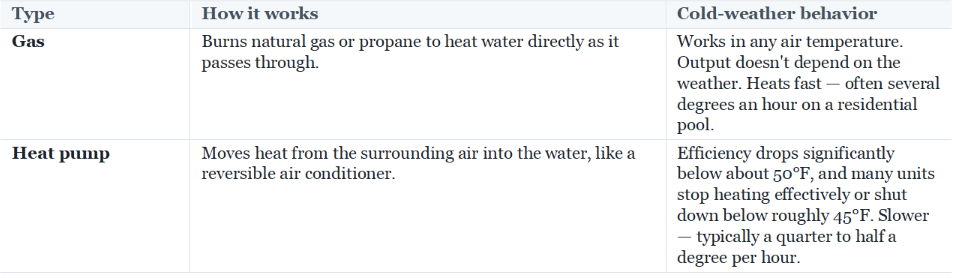
If you have a heat pump and it's 38 degrees outside on a December morning, your heater may be working exactly as designed. That's not a fault — it's physics. Keep reading anyway, because if it's 65 degrees and the water isn't moving, something is wrong.
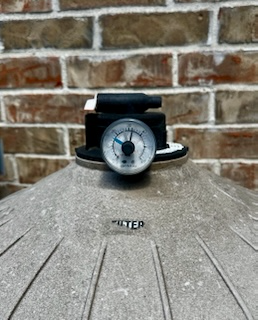
Pool heater digital display showing an error code
Is it actually being asked to heat?
Start with the obvious, because it's more common than anyone admits. Check the setpoint — the target temperature — on the heater or the automation panel. If it's set to 78 and your water is 79, the heater is correctly doing nothing.
Then check the mode. Many heaters and controllers have a "pool" and "spa" setting, and some have a remote or automation override that has been left in the wrong position. If your system is controlled by an app, check the app and the panel — they don't always agree, and the panel wins.
On a gas heater, watch the sequence at the unit. A healthy unit runs a blower purge, proves air flow, then ignites and holds flame. If it never reaches ignition, or lights and drops out after a few seconds, note exactly where it stops — that single observation narrows the fault more than any error code.
Write down any code on the display. Manufacturer codes are specific, and the difference between a flow fault and an ignition fault is usually one digit.
Water flow — the most common cause by a wide margin
Every modern heater is protected against firing with insufficient water moving through the exchanger. Without that protection, a gas burner with no flow will boil water in the exchanger and destroy it in minutes, and a heat pump will slug the compressor.
Two different devices do that job, and knowing which one your unit uses tells you what a false reading looks like.
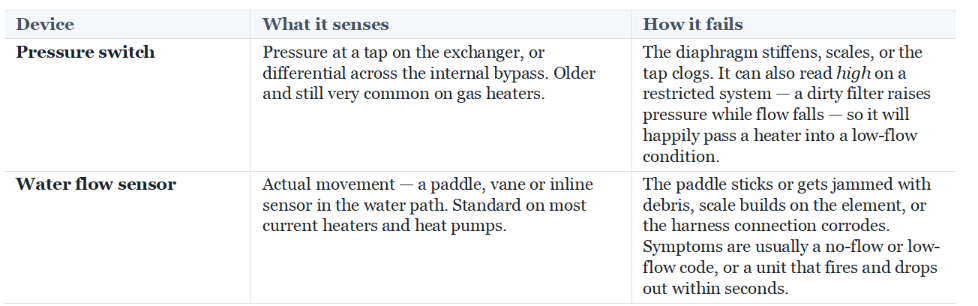
Both devices are safety interlocks, which is why a flow fault presents identically to a dead heater. The heater is not broken — it is refusing to run without water, exactly as designed.
Work these in order:
Filter pressure. Read the gauge against its clean baseline. Eight to ten PSI above baseline means a loaded filter, reduced flow, and a heater that will not stay lit. Clean or backwash, then retest. This alone resolves a large share of no-heat calls.
Pump basket and lid. A clogged basket cuts flow and can cavitate the pump. A lid o-ring that has gone hard lets air in, which collapses flow and confuses the sensor. Clear it, lube or replace the o-ring, restart.
Pump speed. On a variable-speed pump running a low overnight RPM for quiet operation, flow can fall under the heater's minimum. Many gas heaters want somewhere in the 20–40 GPM range; a heat pump typically wants more. Raise the speed and watch whether the unit stays lit.
Valves and bypass. A valve left part-closed, or a manual bypass set so water skips the heater, will trip the sensor every time. Trace the plumbing from pump to heater and confirm every valve is where it should be. A bypass left open after a summer service is a frequent find.
Water level and skimmer. Below the skimmer mouth the pump draws air, flow collapses, and the heater shuts down. Very common in a dry North Texas autumn. Bring the level to mid-skimmer.
The sensor itself. If everything above is clean and flow at the returns feels strong, suspect the switch or sensor. A pressure switch can be tested by jumping it briefly — a technician's test, not a homeowner fix, because defeating a safety interlock and leaving it defeated is how exchangers get destroyed. A flow sensor should be pulled, inspected for debris and scale, and its harness checked for corrosion at the plug.
Gas supply — for gas heaters only
If the heater ignites and then shuts off after a few seconds, or clicks repeatedly without lighting, suspect gas supply before you suspect the control board.
Test another gas appliance in the house. Run the water heater or a stove burner. If they're also weak or out, you have a supply problem, not a pool problem, and your gas utility is the call to make.
Check the shutoff valve at the heater. There's usually a dedicated valve on the gas line near the equipment pad. It should be parallel to the pipe, not perpendicular. If someone serviced the heater and forgot to reopen it, that's your answer.
Consider pressure and sizing. A heater shares the meter with your house. In cold weather, a furnace, a water heater and a pool heater can collectively outrun a meter that was sized for the house alone. If the heater works in October and fails in January, that's a strong hint.
Do not attempt to adjust gas pressure or disassemble a gas valve yourself. That's licensed work, and it's the one part of this list where DIY is genuinely dangerous.
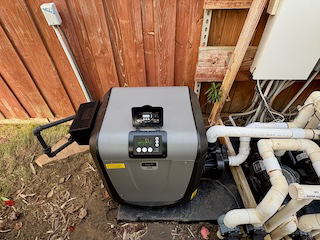
Gas pool heater and pump on an outdoor equipment pad
Ambient temperature — the heat pump ceiling
For heat pump owners, this is usually the whole answer. Heat pumps extract heat from the air, so as the air gets colder there's less heat to extract. Performance falls off meaningfully below 50°F, and below roughly 45°F most residential units either stop producing useful heat or shut down to protect the compressor.
This is why a heat pump that kept a pool at 84 all September seems to have "failed" in December. It hasn't. It has reached its operating limit. In North Texas, a heat pump is an excellent choice for extending the season in spring and autumn, and a poor choice for heating through a January cold snap.
If you want to swim in January here, you need gas — or you need to accept that the pool is closed for six weeks.
Ignition components
Flow proven, gas present, still no heat: the fault is in the ignition chain — igniter, flame sensor, or control board.
An igniter that glows but never lights points at gas. A burner that lights and drops out within seconds is the classic signature of a flame sensor that cannot confirm flame, usually because it is coated. A board that never sends voltage to the igniter is a board fault.
These are inexpensive parts, but diagnosis needs a multimeter, the service manual and the unit's fault sequence. This is the point where guessing gets expensive — parts-swapping a board to avoid a meter reading is how a $60 sensor becomes a $600 repair.
Expectations — the water is losing heat faster than you think
Sometimes nothing is broken and the arithmetic just doesn't work. An uncovered pool in North Texas loses a surprising amount of heat overnight, especially on a clear, windy night. If you're heating to 86 during the day, losing four or five degrees overnight, and expecting the heater to hold temperature in an hour each morning, you'll conclude the heater is failing when it's actually working hard against physics.
A solar cover is unglamorous and it's the single highest-return purchase in pool heating. It cuts overnight losses dramatically and pays for itself in gas in a season or two.
When to stop and call
Get out and call 911 or the gas utility if you smell gas anywhere on the property, or if anyone in the house has headache, nausea or drowsiness while the heater runs.
Shut the unit down and call a technician if you see soot or scorching on the cabinet, hear rumbling or knocking, find the breaker tripping, or see flue products staining or spilling at the vent. Those are combustion and electrical faults, not diagnostics.
Call for a diagnostic visit if you've confirmed clean flow and confirmed gas and it still won't fire, if a flow or pressure code returns after you've cleared the obvious causes, or if the sensor itself tests suspect. At that point repair decisions get interesting, https://www.asppoolco.com/mckinney/services/pool-repairs/ and we've written separately about how we make them.
One more thing worth doing now rather than later: test the heater in October, not the week you want to use it. A heater that sat unused since March has had seven months for a mud dauber to nest in the vent, a sensor to corrode, or a valve to seize. Turning it on in December is how you find out at the worst possible moment — and it's why a pre-winter equipment check is on our autumn list for every pool we maintain.
We service heaters and equipment across McKinney and Collin County https://www.asppoolco.com/mckinney/services/pool-repairs/. If you've worked through this list and it's still cold, that's what we're here for. https://www.asppoolco.com/mckinney/request-service/