


Quick Take
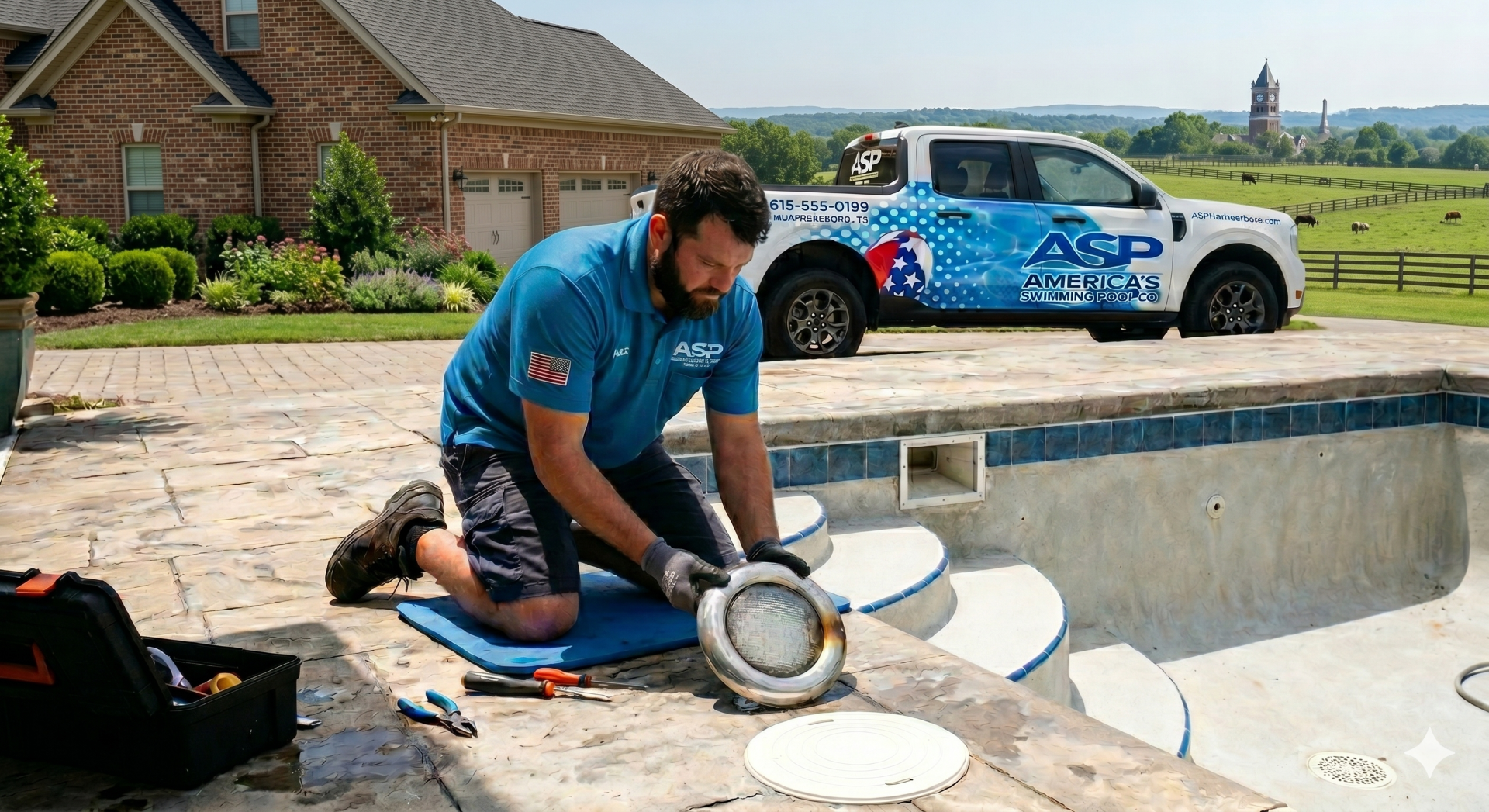
If your pool light has stopped working, the cause is usually one of a few things. Most of the time it's the light itself, the bulb wore out, water leaked in past the front gasket, or water got in through the conduit behind the fixture. But it isn't always the fixture: a tripped or bad breaker, or a worn-out low-voltage transformer, can leave a perfectly good light dark. The fixture problems get solved either with a new LED bulb and gasket installed as a set, or a full fixture replacement when water's coming from behind. An electrical issue is a different fix altogether. The trick is correctly identifying which one you've got, and that's where a knowledgeable local pro earns their keep. We diagnose and fix pool lights every week for homeowners across Murfreesboro, Franklin, Smyrna, Nolensville, and Arrington.
Tennessee Seasons Are Hard on Pool Lights
Here's something a lot of Middle Tennessee pool owners don't realize: our climate is one of the reasons pool lights fail. Unlike year-round swim states, our pools get heavy use all summer and then sit quiet, often covered, through a cold winter. That cycle, hot to cold and back again, makes the rubber seals inside a pool light expand and contract over and over. Add in the occasional hard freeze, and the gaskets and O-rings that keep water out slowly lose their grip.
So when a Murfreesboro-area pool light starts fogging, flickering, or going dark in early summer, it's frequently a seal that quietly gave up over the winter. The good news: caught early, it's usually a simple repair. Let it go, and water reaches the electrical components, and the job gets bigger.
A Quick Anatomy Lesson (So the Rest Makes Sense)
A traditional pool light system has a few parts that matter for repairs:
- The bulb, which produces the light.
- The lens and gasket, the glass cover and the rubber seal that keeps water out of the housing.
- The cord and conduit, the wiring that runs from the back of the fixture, through a pipe, to a junction box up on the deck.
- The power supply, the breaker that feeds the circuit and, on low-voltage systems, the transformer that steps the power down to the light.
Almost every failure traces back to one of those parts. Knowing which one is the difference between a quick fix and an unnecessary replacement, and it's why we never quote a job before we understand what actually went wrong, starting at the power source and working our way to the fixture.
How We Diagnose a Failed Pool Light
Scenario 1: It's the breaker or transformer, not the light
The first thing we check is the power. A tripped or failed breaker can shut the light off completely, and on a low-voltage setup, a worn-out transformer can do the same even when the light is perfectly good. This is the easiest fix of all, and checking it first means we never recommend opening up (or replacing) a fixture that was never the problem.
Scenario 2: The bulb reached the end of its life
Older incandescent and halogen bulbs only last about 1,000 to 5,000 hours, frequently just one to three Tennessee swim seasons. A simple burnout is a best-case fixture issue, because it's the easiest path to a modern LED upgrade.
Scenario 3: The front gasket let water in
Over years of temperature swings, the lens gasket hardens and cracks until water seeps past it and reaches the bulb. This is one of the most common failures we find on established pools across Rutherford and Williamson Counties.
Scenario 4: Water came in behind the fixture
Where the cord enters the housing and runs into the conduit, a failed seal can let water in from behind, a spot that's impossible to see from the deck. This is the most serious of the bunch and it changes our entire recommendation.
We'll be straight with you about something the industry doesn't always admit: from the surface, a dead transformer, a front-gasket leak, and a behind-the-fixture leak can all leave you staring at the same dark light. Pinning down the real source sometimes takes more than one visit. We'd rather tell you that plainly than take a wild guess on your dime.
Repair vs. Replace: The Rule We Follow
If it's the bulb or the gasket, both get replaced together
On the Pentair Amerlite-style fixtures found in most older Middle Tennessee pools, we always replace the bulb and the gasket as a pair. Here's why that's not upselling, it's good practice:
To reach the bulb, we have to open the lens, which means removing the gasket. That gasket can't be safely reused, putting an old seal back in is the number-one reason a "fixed" light starts leaking again weeks later. And if a bad gasket is what let water in to begin with, the new gasket is literally the repair. With the fixture already open, upgrading the dated bulb to a long-lasting LED at the same time just makes sense.
Bottom line: worn-out bulb or leaky gasket, the service is the same, a fresh LED bulb and a new gasket in a single visit. Most Amerlite fixtures accept a screw-in (Edison base) LED, so you get the efficiency upgrade without touching the niche or the wiring.
If it's the conduit, the fixture gets replaced
When water is coming from the cord-and-conduit connection behind the fixture, the housing is compromised and a full replacement is the right answer. We also watch for a clear signal: if we've already done a bulb-and-gasket repair and water still returns, the leak is behind the fixture where it can't be sealed from the front. Replacing the whole light then is the reliable fix that saves you from paying to chase the same leak twice.
LED Upgrade Options: Two Directions to Go
LED has taken over the industry, and that's a win for pool owners. Every major brand, Pentair, Hayward, Jandy, and more, offers LED replacements that fit the niche sizes of older pools. Your main choice is the look.
White LED delivers bright, clean, efficient light, perfect if you just want great visibility for an evening swim. It's typically the most budget-conscious upgrade.
Color-changing LED is the one that wows people. It cycles through solid colors and programmed light shows you control from a switch, remote, or smartphone app. For the newer luxury homes going up around Franklin, Nolensville, and Arrington, it's become almost a standard expectation for the backyard.
Whichever you choose, LED pays off. These lights last 20,000 to 30,000 hours, roughly 10 to 20 years, compared to one to three years for the old bulbs. They run cooler, draw far less power, and end the annual ritual of calling someone out to replace a burned-out bulb.
Niche Lights vs. Nicheless "Pipe" Lights
Knowing which kind you have tells you what your repair will involve.
If your pool is older, you almost certainly have a large fixture set into a recessed niche, with the cord running through conduit to a deck-mounted junction box. These give you the most options, a bulb-and-gasket LED upgrade, or a full fixture replacement.
If your pool is newer, especially in the recent subdivisions around Franklin, Nolensville, and Smyrna, you may have nicheless lights instead. These thread directly into a standard 1.5-inch pool wall fitting, the same size pipe used for return jets, with no niche required. Compact lights like the Pentair MicroBrite are made for this and run on low-voltage (typically 12V) wiring back to a transformer or junction box.
The important difference: a nicheless light has no replaceable bulb. The light and cord are one sealed unit, so when it fails, the repair usually means pulling an entirely new light through the pipe from the junction box, a different kind of job than a traditional fixture.
The Next Generation: Plug-and-Play Pool Lights
Pool lighting keeps getting easier to live with. Manufacturers are now making plug-and-play lights built for simple replacement, instead of running a new cord all the way back to the junction box, you twist the old light out to unplug it and twist the new one into place. Several brands are adding this to their newest nicheless and retrofit lines, and it signals a future where replacing a pool light is a quick swap rather than a major service call.
Building a new pool or planning a big lighting upgrade? Ask us whether a plug-and-play system is a smart fit. It can meaningfully lower the cost and effort of every replacement you'll ever do on that pool.
Pool Light Costs in the Murfreesboro Area (2026)
Pricing depends on the light type, your pool's construction, and any electrical work involved, but here are realistic ranges:
- LED bulb + gasket, installed: about $300–$500, including the upgraded LED bulb, a new gasket, and labor. Because the two are always done together, it's a single service, not two line items.
- Full LED fixture, installed: generally $1,000–$2,500 per light, driven largely by the brand and model you select and whether any conduit or junction-box work is required.
- Color-changing systems and multi-light setups: at the higher end or beyond, particularly when a controller or wiring update is added.
Pools 15 years and older sometimes need conduit or junction-box work, which adds to the project. The only way to give you an accurate figure is to look at your specific pool, and we're always glad to provide a clear, written estimate before any work begins.
Murfreesboro Pool Light FAQs
Do you serve Franklin, Smyrna, Nolensville, and Arrington too? Yes, our service area covers Murfreesboro, Franklin, Smyrna, Nolensville, Arrington, and the surrounding Middle Tennessee communities. If you're unsure whether you're in range, just reach out and we'll confirm.
Do you have to drain the pool to fix the light? In the vast majority of cases, no. We remove the fixture and bring it up onto the deck to service it, so your water level stays put.
My pool was winterized and now the light won't come on. Is that related? It often is. The freeze-and-thaw cycle our winters put pools through is hard on light seals, and a light that worked fine in the fall sometimes fails when you fire everything back up in spring. It's usually a straightforward bulb-and-gasket repair.
There's water inside the lens but the light still works. Can it wait? It's best not to wait. Water in the lens means the seal is already failing, and continued moisture around the electrical parts is both a reliability and a safety concern. Addressing it early usually keeps it in repair territory rather than full replacement.
Can I just swap in an LED bulb on my own? Many fixtures will take a screw-in LED, but two things trip people up. The gasket must be replaced at the same time (it can't be reused once the lens is opened), and the voltage, 12V or 120V, has to match your system precisely. A mismatch can destroy the bulb or create a hazard, which is why we recommend professional installation.
My light won't turn on at all, does that mean the fixture is bad? Not always. The first thing we check is the power. A tripped or failed breaker, or a worn-out low-voltage transformer, can leave a perfectly good light dark, and both are simpler, cheaper fixes than anything involving the fixture. Checking the power source first means we never recommend replacing a light that was never the problem.
How many lights do I need for good coverage? A single light often leaves dark corners and shadowed steps. Larger or irregularly shaped pools usually look and swim better with two or more fixtures positioned to overlap. We're happy to assess your pool and recommend placement.
Ready to Light Up Your Backyard?
Getting the diagnosis right is what separates a sensible repair from an unnecessary fixture replacement, and it all comes down to knowing where the water is getting in. That's our specialty, and we do it day in and day out for pool owners throughout Murfreesboro, Franklin, Smyrna, Nolensville, and Arrington.
Whether you need a bulb-and-gasket LED upgrade, a full fixture replacement, or you'd like to explore color-changing and plug-and-play options, we'll walk you through every choice and help you pick what fits your pool and your budget.
Contact ASP of Murfreesboro today to schedule your pool light evaluation, and let's bring your pool back to life after dark.
How to Reach Us
Ready to schedule, or have a question first? There are two easy ways to get in touch with ASP of Murfreesboro:
- Call us: (629) 335-3829
- Request service online: Visit asppoolco.com/murfreesboro and submit a request through the contact form, and we'll follow up promptly.
We proudly serve Murfreesboro, Franklin, Smyrna, Nolensville, Arrington, and the surrounding Middle Tennessee communities.
Provided as general guidance by ASP — America's Swimming Pool Company of Murfreesboro and the surrounding areas. Pool light and electrical work should always be handled by a qualified pool professional. TN License #82335.